




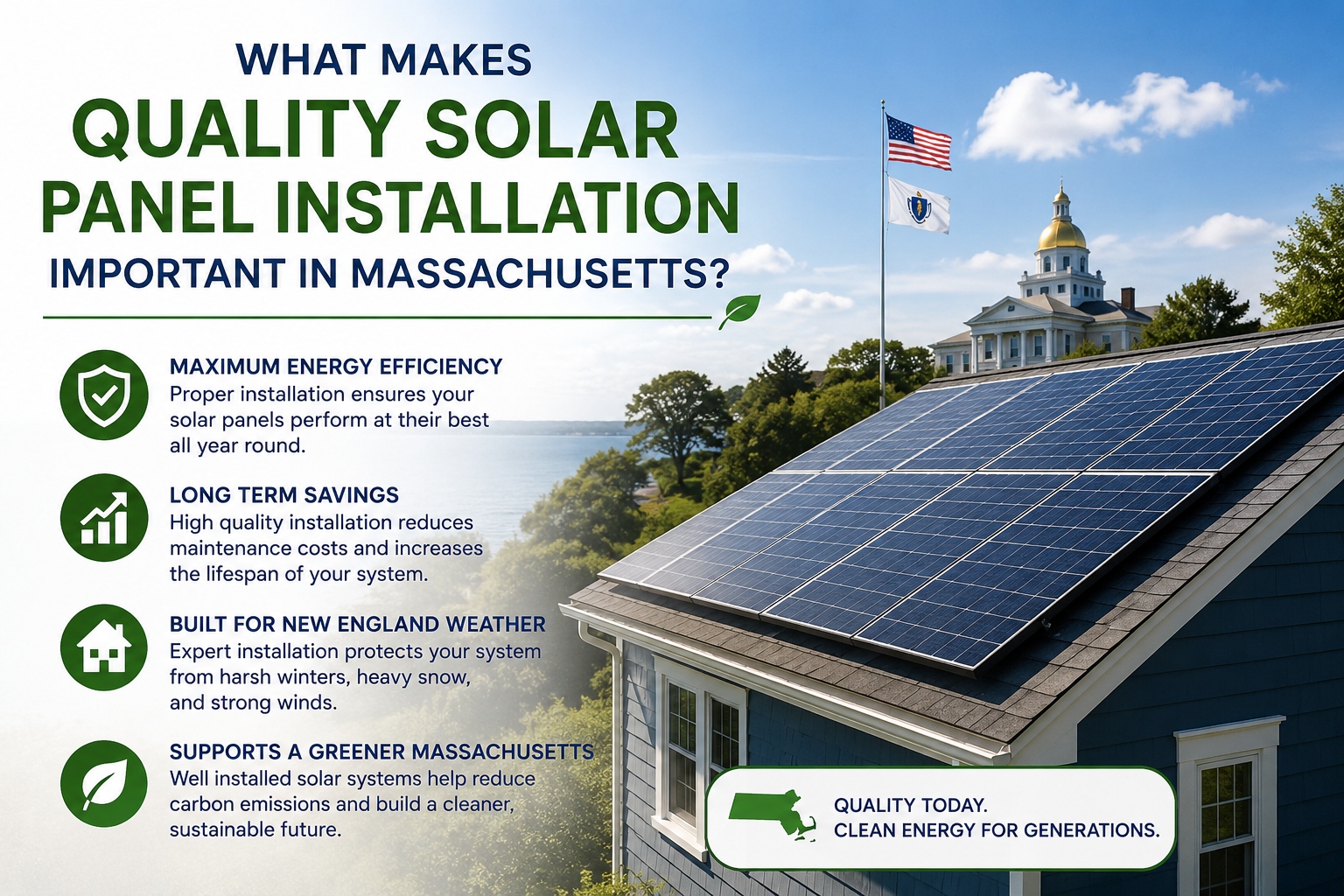
Snow sits on a roof for weeks at a stretch, and a poorly mounted solar panel does not carry that weight the way a properly installed one does. Quality shows up years later, whether the racking survives a heavy snowfall or the output still holds after a decade of freeze-thaw cycles. Solar panel installation in Massachusetts faces demands most warmer states never plan for, and a shortcut taken here costs more than any upfront savings offer.
There are many residents who rely on Clean Solar Energy to receive solar solutions that are
built around their requirements, with a focus on making sure that the system performs reliably
over the long term as well as maximising energy savings.
Factors That Make Quality Solar Panel Installation Important in Massachusetts
High electricity rates and a demanding climate put more pressure on a solar system here than in most states, which makes the quality of that installation the deciding factor between decades of reliable output and years of costly repairs.
Several factors make solar installation especially important in this environment:
- Rising utility costs.
- Long, snow-heavy winters.
- Strict building and permitting codes.
- State incentives and net metering rules.
- Roof durability over time.
- Long-term system performance.
1. Rising Electricity Costs
Electricity in Massachusetts costs more than in almost any other state, and the gap keeps growing year after year. A system installed correctly for this state’s conditions is what turns that trend into real savings, not a number promised on a sales sheet.
Savings hold up over time because of:
- Correct panel orientation for maximum sun exposure.
- Inverter sizing matched to household load.
- Wiring built for New England’s temperature swings.
- Output that holds steady across the system’s full lifespan.
2. Long, Snow-Heavy Winters
A roof carries snow for weeks at a stretch, not days, and that weight lands directly on whatever racking holds the panels down. Winter here typically runs from late November into March. Every mounting point on the roof takes that load the entire time. Whether the system performs well depends heavily on decisions made long before the first snowfall.
Panel Angle and Snow Shed
Steep enough, and snow slides off a panel on its own. Too flat, and it piles up storm after storm, leaving panels buried and producing nothing for days at a stretch.
Racking Strength Under Load
A rack rated for local snow load survives a nor’easter. One that isn’t can buckle or pull loose from the roof entirely under weight it was never built to carry.
Roof Penetration and Ice Damming
Each mounting point breaks through the roof surface, and ice forming along the eaves turns that point into a place water can get in. Flashing and sealing done right at each one keeps water out during a thaw.
Cold-Weather Electrical Performance
Wiring cracks, connectors corrode, freeze and thaw repeat that cycle season after season. Materials built for that swing keep producing power years after cheaper components would have already given out.
3. Strict Building and Permitting Codes
Codes shift from one Massachusetts town to the next, and a permit missing even one local requirement stalls a project before installation ever starts. An installer unfamiliar with a specific town’s rules risks a delay, a failed inspection, or a rebuild after the panels are already mounted.
A permit clears on schedule when it accounts for:
- Local zoning and setback compliance.
- Structural engineering documentation where required.
- Electrical code compliance for grid interconnection.
- Fire code clearances around roof-mounted panels.
- Utility interconnection approval before activation.
4. State Metering Incentives
Massachusetts backs solar energy with more than sun exposure, through incentive programs and net metering that pay off when an installation qualifies for them correctly. A system installed outside program requirements can lose eligibility for credits it was counted on to earn.
Eligibility for these programs comes down to:
- SMART program enrollment and compliance.
- Correct system sizing for incentive tiers.
- Net metering credit qualification.
- Interconnection agreement with the utility.
- Federal tax credit documentation.
5. Roof Durability Over Time
A roof holding solar panels carries some load it was still not designed to handle on its own. Solar panel installation in Massachusetts has to account for that stress across decades, not just the day the system switches on. Poor mounting work compromises a roof long before the panels sitting on top of it stop producing.
Roof durability under a solar system depends on:
- Flashing quality at every mounting point.
- Roof material compatibility with the racking system.
- Weight distribution across roof trusses.
- Sealant performance through repeated freeze-thaw cycles.
- Roof age and remaining lifespan before installation.
Why Choose Clean Solar Energy?
Choosing the right installer is as important as selecting high-grade hardware for your roof. End-
to- end residential solar solutions prioritise premium components, precision workmanship and
dedicated customer support to make sure that transition remains seamless. Years of industry
expertise allow professional teams to guide homeowners through every phase with complete
confidence.
Homeowners often benefit from:
● Tailored system designs
● High-efficiency hardware
● Expert installation
● Permit and incentive support
● Transparent cost structure
● Continuous maintenance
● Active performance tracking
With years of industry expertise, Clean Solar Energy helps homeowners transition to
renewable energy with confidence.
Save More with Solar Energy Solutions in Massachusetts
Investing in solar energy solutions in Massachusetts is a long-term financial decision that
delivers ongoing savings. Beyond reducing electricity bills, solar systems contribute to a cleaner
environment while increasing your home’s market appeal. As energy costs continue to rise,
homeowners who install solar today can enjoy predictable energy expenses and greater peace.
Final Thoughts
Eventually, all these factors work together. Snow load, permitting rules, incentive eligibility, roof durability- each one feeds into the next. A shortcut taken tends to show up as a failure in another year later. Solar panel installation in Massachusetts demands attention to all of it at once, not a checklist run through in sequence and forgotten.
A homeowner weighing solar is really weighing an installer’s grasp of these conditions, not just the price on a quote. Contact Clean Solar Energy for the most reliable solar panel installation. When you install solar panel, you improve your savings in the future and do not rely on traditional grid systems.
Get Started with Clean Solar Energy Today
Ready to increase your home’s value while lowering energy costs? Clean Solar Energy can help
you make the switch to clean, renewable power with a customised solar solution designed for
your needs.
Visit: https://cleansolarenergy.ai/ to schedule your consultation and discover the benefits of
solar energy solutions in Massachusetts today.
Contact Us: +1 (339) 293-1010
Whatsapp:
+1 (978) 476-6610
Email address:
support@cleansolarenergy.ai
