




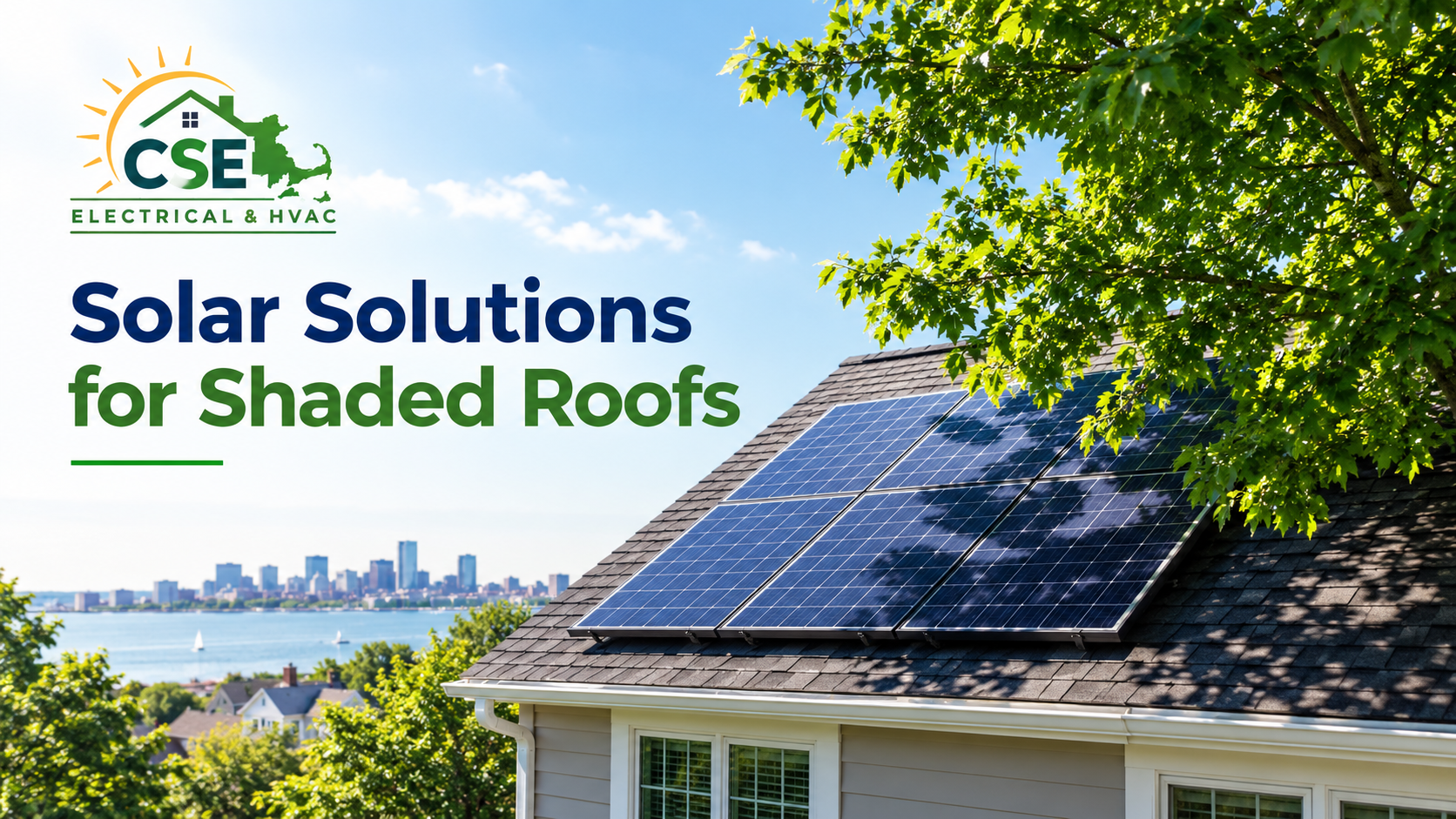
If your Massachusetts home or building has a few tall oak trees, a chimney, or a neighbor’s roofline casting shadows, you may have been told solar “won’t work” for you. That’s often not true. Partial roof shading is a design challenge, not a deal-breaker. With the right equipment and layout, many shaded properties across Massachusetts still produce strong savings.
How Does Shade Affect Solar Panels?
Solar panels are wired together, and in a traditional “string” system, panels behave a bit like holiday lights: one heavily shaded panel can drag down the output of the whole string. That’s why a shadow on a small part of your roof can cause a bigger production drop than you’d expect.
The good news:
- Shade is rarely all day. A tree may shade one section of your roof only in early morning or late afternoon.
- Not every roof section is affected. Many roofs have a mostly clear south, east, or west face.
- Modern technology limits the damage. Panel-level electronics isolate shaded panels so the rest keep producing.
A professional shade analysis measures all of this so your estimate is based on real numbers, not guesswork.
Why Shade Is a Bigger Question in Massachusetts
Massachusetts has dense tree cover, older neighborhoods with mature trees, and closely spaced buildings, especially in cities like Boston, Cambridge, Worcester, and Springfield. Two local factors matter:
- Low winter sun angles. In December and January, the sun sits low in the sky, so shadows stretch much longer than in summer. A tree that doesn’t shade your roof in July may shade it in January.
- Seasonal tree cover. Deciduous trees block light in summer but let much more through in winter, when sunlight is already limited.
Because your highest-production months are typically spring through early fall, summer shading patterns often matter most for annual output and savings.
6 Solar Solutions for Partially Shaded Roofs
1. Microinverters
A microinverter is attached to each panel (or pair of panels) and converts power right at the source. If one panel is shaded, the others keep working at full capacity. This is one of the most popular choices for roofs with uneven shade.
2. Power Optimizers
Optimizers are installed on each panel and condition the electricity before it travels to a central inverter. Like microinverters, they reduce the “weakest link” problem and add panel-level monitoring, so you can see exactly how each panel performs.
3. Smart Panel Layout and System Design
Good design is often the cheapest fix. Installers can:
- Place panels only on the sunniest roof sections
- Group shaded panels on their own circuit or string
- Use east-west layouts to capture morning and afternoon sun
- Choose higher-efficiency panels to produce more from a smaller sunny area
4. Tree Trimming or Removal
Sometimes the simplest answer is trimming a few branches. Pruning can recover a meaningful amount of production, and the cost may be small compared with the lifetime value of the system. Always check local rules and consult an arborist, especially for large or protected trees.
5. Ground-Mount, Carport, or Garage Systems
If your roof is heavily shaded but your yard or driveway gets plenty of sun, a ground-mounted array or solar carport may be a better fit. You can choose the exact location and tilt for maximum production. For businesses, carports can also provide covered parking.
6. Battery Storage
Batteries don’t remove shade, but they help you get more value from the energy you produce. You can store daytime solar energy for evening use and keep key circuits powered during outages, which are not uncommon during New England storms.
Microinverters vs. Power Optimizers vs. String Inverters
| Feature | String Inverter | Power Optimizers | Microinverters |
|---|---|---|---|
| Handles partial shade | Poor | Good | Excellent |
| Panel-level monitoring | No | Yes | Yes |
| Upfront cost | Lowest | Moderate | Moderate to higher |
| Best for | Unshaded, simple roofs | Mixed shade, complex roofs | Heavy or varied shade, multiple roof faces |
The right choice depends on your roof, budget, and shading pattern. A site-specific assessment will tell you which one pays off best.
What Makes a Roof “Good Enough” for Solar?
There’s no single cutoff, but installers generally look at:
- Solar access: the percentage of sunlight your roof actually receives compared with an unshaded site. Many properties with some shade still perform well.
- Roof direction and tilt: south-facing roofs are ideal in Massachusetts, but east and west faces can also work well.
- Roof condition and age: if a roof needs replacing soon, it’s smart to do it before or alongside installation.
- Available space: more usable space means more flexibility to avoid shaded areas.
Massachusetts Incentives That Improve the Math
Massachusetts has some of the more supportive solar policies in the country. Programs can change, so confirm current details before deciding, but these are the main ones to ask about:
- Net metering: excess solar energy sent to the grid can earn credits on your utility bill.
- SMART program (Solar Massachusetts Renewable Target): a state incentive that pays for solar energy produced, with rates that vary by system size and utility territory.
- State tax incentives: Massachusetts offers a personal income tax credit for residential solar, plus exemptions from sales tax on solar equipment and from added property tax on the value solar adds to a home.
- Federal incentives: federal solar tax rules have changed recently, and eligibility differs for homeowners and businesses. Talk to a tax professional and your installer about what applies to your project and timeline.
Because shaded systems may produce a bit less, incentives that pay per kilowatt-hour or credit your bill can still make a strong financial case when the system is designed correctly.
How to Know If Solar Is Right for Your Shaded Property
- Get a professional shade analysis. On-site tools and satellite modeling show how sunlight moves across your roof through the year.
- Compare production estimates. Ask for projected annual kWh output that accounts for shading, not an unshaded best-case number.
- Review equipment options. Ask whether microinverters or optimizers make sense and what the added cost buys you.
- Consider alternatives. Ground mounts, carports, or trimming trees may beat a shaded rooftop.
- Calculate the payback. Look at your electric rates, incentives, and expected output to estimate savings over time.
Get a Shade-Smart Solar Plan for Your Massachusetts Property
Partial roof shading doesn’t have to stop you from saving money and cutting your carbon footprint. The key is a design built around your actual roof, your trees, and your energy use.
Clean Solar Energy can evaluate your property, model partial roof shading how shade affects production, and recommend the right mix of equipment and layout for your goals.
