





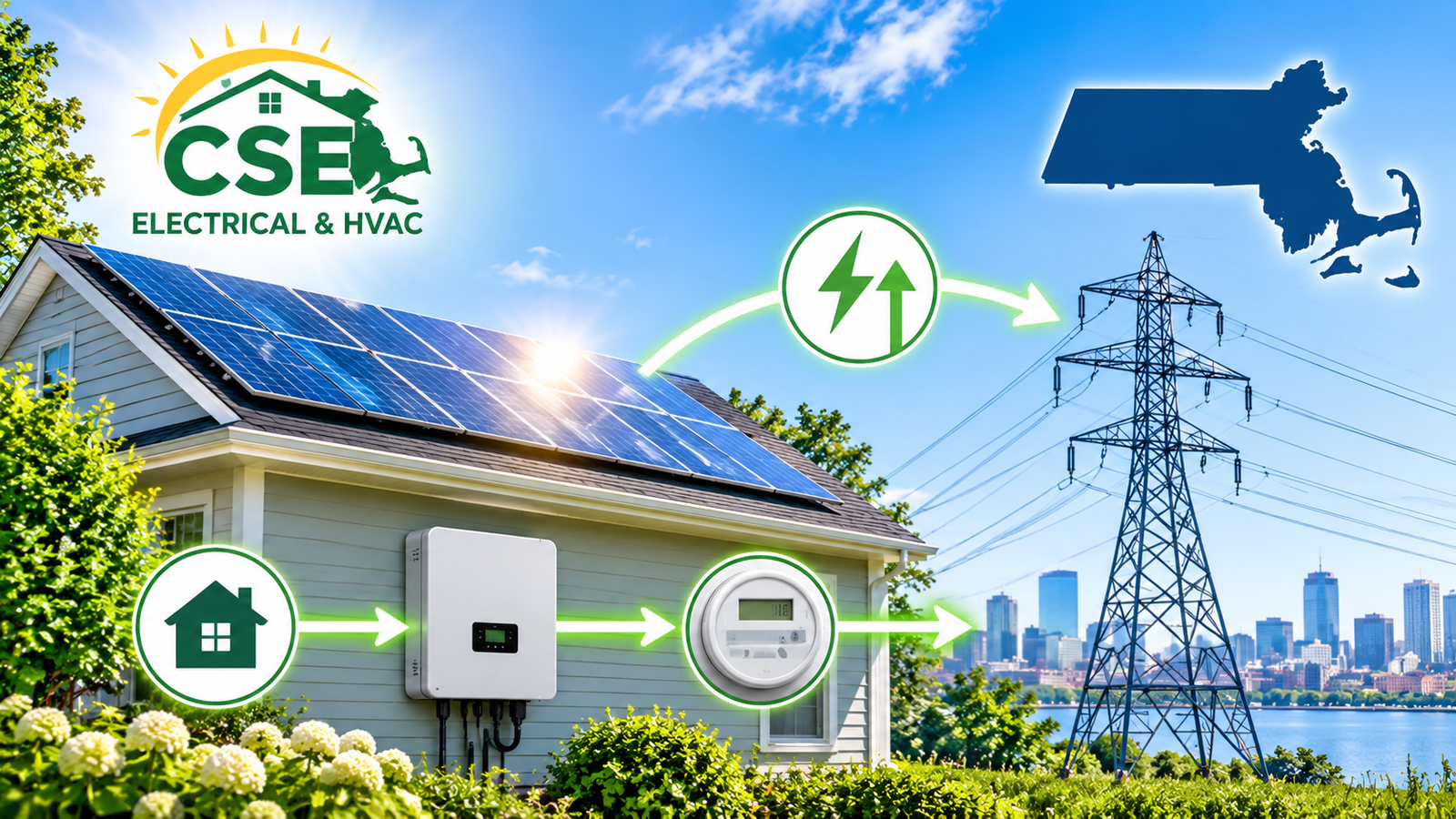
If you are planning a solar power installation in Massachusetts, one question matters more than most homeowners expect: what happens to the electricity your panels make but your home does not use? That surplus is called exported electricity, and how it is credited can change your payback time, your system size, and even your equipment choices
What Is Exported Electricity?
Your solar panels produce the most power in the middle of the day, often when nobody is home. Whatever your house cannot use in that moment flows out through your meter to the utility grid. That outflow is your exported electricity.
When the sun goes down or the weather turns, the flow reverses and you draw power from the grid as usual. Over a month, your bill reflects both directions.
How Net Metering Works in Massachusetts
The main way Massachusetts homeowners get value from exports is net metering. In simple terms:
- Your solar system powers your home first.
- Extra electricity goes to the grid and earns a credit on your utility bill.
- When you use more than you produce, such as winter evenings, those credits offset what you would otherwise pay.
- Credits that go unused generally carry forward, so a sunny summer can help cover darker months.
If you are a customer of Eversource, National Grid, or Unitil, you can net meter. According to the Massachusetts net metering guide, credits can reduce your bill all the way to zero dollars and zero kilowatt-hours of billed usage, but you still pay for the net electricity you consume.
Why this matters: electricity you use directly from your panels avoids a utility charge entirely. Electricity you export is valued through the net metering credit. Both help, but the exact value of each depends on your utility and rate class.
Is the Credit Always the Same? Not Quite
Three things make the value of your exported electricity vary from one home to another.
Your utility. Eversource, National Grid, and Unitil each have different retail rates, so the same kilowatt-hour of export can be worth a different amount depending on who serves your address.
Your system size and class. Most home systems fall into the residential net metering class, which is the most favorable. Larger systems can be treated differently, which is one reason proper sizing matters (more on that below).
Municipal light plants. If your electricity comes from a town-owned utility rather than an investor-owned one, you may follow different rules. For example, Concord Light replaced its residential net metering with banking rate with a net billing rate starting April 1, 2026, where exported solar is credited at different values depending on when it is sent to the grid. If you live in a town with its own light plant, confirm the local policy before designing a system.
Net Metering vs. the SMART Program
Homeowners often mix these up, but they are separate:
- Net metering credits you for exported electricity on your bill.
- SMART (Solar Massachusetts Renewable Target) is a state incentive that pays you per kilowatt-hour your system produces for a set period, whether you use that power or export it.
In practice, a Massachusetts solar owner can benefit from both at once. The SMART payment rate and rules are updated by the state, so ask your installer for the current residential rate and eligibility before you rely on any number you see online.
What Could Change: The DPU Review
Here is the part many homeowners are not hearing about. On December 15, 2025, the Massachusetts Department of Public Utilities opened docket D.P.U. 25-200, a broad review of electric and gas delivery charges. One of its stated objectives is to compare the value of net metering credits in Massachusetts with similar programs elsewhere and consider whether that value should be adjusted, with a goal of reducing costs.
What we can say honestly:
- It is an active review, not a final rule change.
- Public comment periods have already run.
- Several solar and utility sources we checked reported no ordered change to residential credits at the time of their updates, but this is moving, so verify the latest status with the DPU or your installer before you decide.
- Any new rules would likely apply to future systems, and many policies in other states have included transition or grandfathering periods.
This is not a reason to panic or rush. It is a reason to work with an installer who tracks policy and models your savings under more than one scenario.
Don’t Forget the Federal Tax Credit Change
The federal residential clean energy credit (Section 25D) is not available for solar property placed in service after December 31, 2025. Because that credit no longer reduces the cost of a homeowner-purchased system, state-level value, including net metering credits, SMART payments, and Massachusetts incentives, plays a bigger role in the math. Ask your installer which state incentives you qualify for, and talk with a tax professional about your own situation.
How Exports Should Shape Your System Design
A good solar design is not about the biggest system your roof can hold. It is about the right system for your usage and your utility’s rules.
Size to your consumption. Producing far more than you use can leave you with surplus exports that are worth less than offsetting your own bill, or that fall into a less favorable credit category. If you plan to add a heat pump or an EV, mention it early so we can design for that future load.
Check your roof and surroundings. Trees and seasonal shade directly reduce production. Our guide to how trees and seasonal shade affect solar panels for homes in Massachusetts explains what to look for before you commit.
Make sure your electrical panel is ready. Older panels and limited capacity can force upgrades, which affect your budget and timeline. Read our walkthrough on preparing your electrical panel for solar and battery storage to see what installers check.
Should You Add Battery Storage?
If exported electricity is credited close to the retail rate, a battery is not always necessary for savings. But batteries can make sense if:
- You want backup power during outages.
- Your utility or town light plant values exports at lower or time-varying rates.
- You want to use more of your own solar production at night.
If you are weighing this, explore our battery storage solutions and other solar services and ask for a side-by-side comparison with and without a battery.
From Installation to Export: Interconnection and Utility Approval
Your panels cannot legally export power until the utility approves your connection. This step, called interconnection, is where many homeowners experience delays between finishing the install and flipping the switch.
To set expectations, read our article on interconnection delays and utility approvals in Massachusetts. The timing of your permission to operate can affect when credits and incentives begin, so ask your installer how they manage paperwork and follow-up.
Track What You Export After Installation
Exported electricity is only valuable if your system is performing. A monitoring app lets you see production, spot drops, and compare your output with your bills. Learn how monitoring systems detect underperforming solar panels, and see our questions to ask a solar company in New England about monitoring and after-sales support.
Warranties matter here too. Before signing, review how to evaluate solar equipment warranties in New England.
Checklist: Questions to Ask Before You Sign
- Which utility or municipal light plant serves my address, and what is the current export credit policy?
- What net metering class will my system fall into?
- How much of my production will I use directly versus export?
- How would my savings change if export credits were reduced in the future?
- Which state incentives, including SMART, am I eligible for right now?
- What is the expected interconnection timeline, and who handles the utility paperwork?
- Will my electrical panel need an upgrade?
- What monitoring and support come after installation?
Get a Solar Plan Built Around Your Exports
Clean Solar Energy is a local Massachusetts company based in Saugus, and you can learn more about our team, browse our recent projects, or see all of our solar services. Own a business property? We also offer commercial solar panel installation in Massachusetts.
Ready to see how much of your solar production you would use and how much you would export? Contact us for a free consultation or call +1 (339) 293-1010.
